Astrophysics
Supermassive black holes and the dynamics of galaxies — the research of Remco van den Bosch
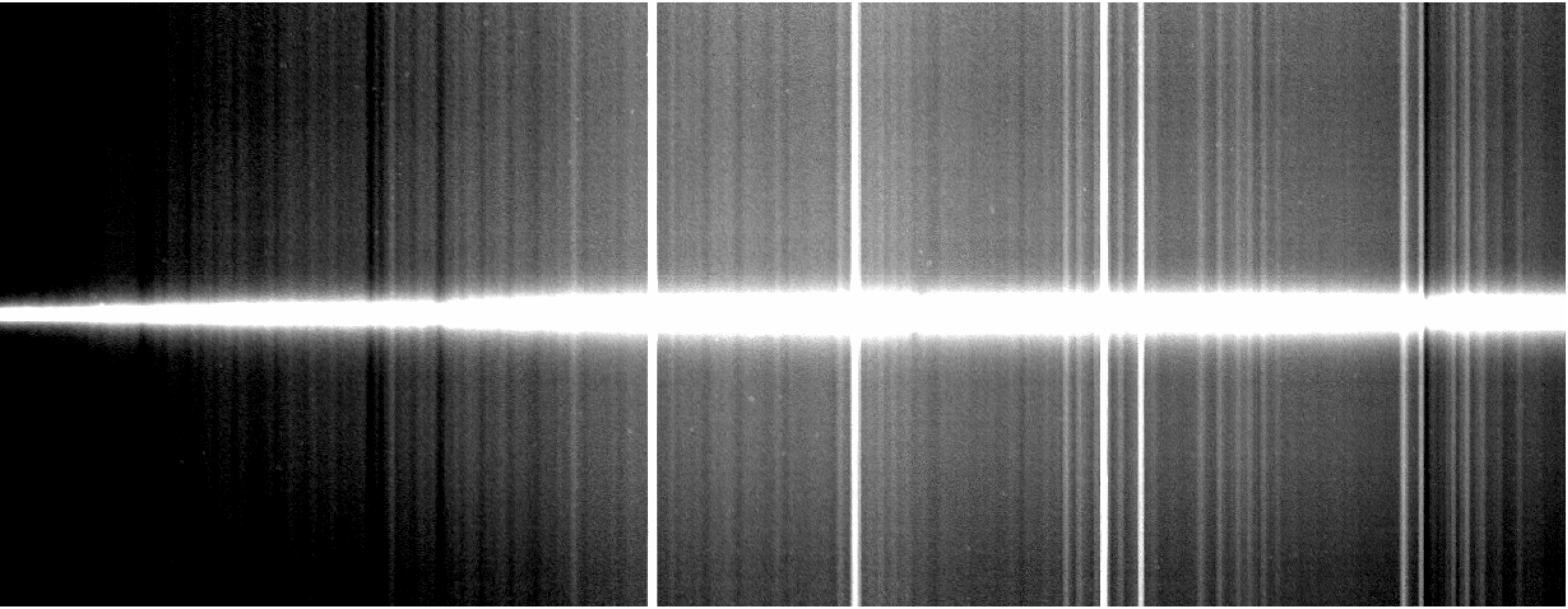
How do you weigh something you cannot see? For about fifteen years, that question drove this research. The supermassive black holes at the centres of galaxies give themselves away only through gravity, in the way the surrounding stars move. The motions are written into the starlight: as stars swing around in their galaxy, the lines in their spectra shift and smear. Reading them takes software at every step — pipelines that clean raw telescope data, tools that pull stellar speeds from the spectra, and orbit models that find the unseen mass those speeds require.
This page is a record of that work between 2002 and 2018: weighing black holes and mapping how stars move inside galaxies. The highlights are the discovery of an over-massive black hole in the compact galaxy NGC 1277, the HET Massive Galaxy Survey, which sifted 1,022 nearby galaxies for the ones where a black hole can actually be weighed, and a relation tying the masses of hundreds of black holes to the structure of their hosts. These sit among more than sixty peer-reviewed papers, two of them in Nature (1, 2) and one in Science. Every paper links to its permanent home (DOI), the free arXiv version and its ADS entry; the complete list is also on ADS, and on ORCID. The marked papers in each list are the ones worth clicking first.
Weighing supermassive black holes
A galaxy and the black hole at its centre seem to grow up together. The black hole’s mass tracks properties of the host — most tightly the velocity dispersion of its stars, the typical speed of their random motions — even though the two differ in size by orders of magnitude. These scaling relations are how black-hole masses are estimated across the universe, so whether they hold everywhere or merely on average matters.
Testing that means weighing individual black holes directly, from the motions of stars or of gas in maser disks, for hosts ranging from giant ellipticals down to ultra-compact dwarf galaxies barely larger than a star cluster. The HET Massive Galaxy Survey supplied the targets. Over 200 nights on the 10-metre Hobby-Eberly Telescope, it took a spectrum of each of 1,022 nearby galaxies, run through a purpose-built pipeline. A black hole can only be weighed inside its sphere of influence — the central region where its gravity outpulls everything else — and on the sky that region is about the size of a coin seen from five kilometres away. The survey picked out the galaxies where it is largest: the ones where a mass can actually be measured.
Brought together, the masses of some 230 black holes — from dwarf galaxies to the giants at the centres of galaxy clusters — lie close to a single relation: a black hole’s mass tracks, above all, how fast its host’s stars move. On that reading, the long-known link to the stellar bulge is mostly a shadow of that deeper relation. There is a catch: only galaxies with a large enough sphere of influence make it into the sample, so the measured ones lean dense. Of those, most obey the relation. A handful do not.
-
The black hole in NGC 3379: a comparison of gas and stellar dynamical mass measurements with HST and integral-field data
DOI · arXiv · ADS -
Estimating black hole masses in triaxial galaxies
DOI · arXiv · ADS -
A Stellar Dynamical Mass Measurement of the Black Hole in NGC 3998 from Keck Adaptive Optics Observations
DOI · arXiv · ADS -
An over-massive black hole in the compact lenticular galaxy NGC 1277 (recommended)
DOI · arXiv · ADS -
A supermassive black hole in an ultra-compact dwarf galaxy
DOI · arXiv · ADS -
The Black Hole in the Compact, High-dispersion Galaxy NGC 1271
DOI · arXiv · ADS -
A 5 × 10⁹ M☉ Black Hole in NGC 1277 from Adaptive Optics Spectroscopy (recommended)
DOI · arXiv · ADS -
Toward Precision Supermassive Black Hole Masses Using Megamaser Disks
DOI · arXiv · ADS -
Stellar Populations across the Black Hole Mass-Velocity Dispersion Relation
DOI · arXiv · ADS -
A Black Hole Mass Determination for the Compact Galaxy Mrk 1216
DOI · arXiv · ADS -
Detection of Supermassive Black Holes in Two Virgo Ultracompact Dwarf Galaxies
DOI · arXiv · ADS -
Hunting for Supermassive Black Holes in Nearby Galaxies With the Hobby-Eberly Telescope (recommended)
DOI · arXiv · ADS -
Unification of the fundamental plane and Super Massive Black Hole Masses (recommended)
DOI · arXiv · ADS
Compact and relic galaxies
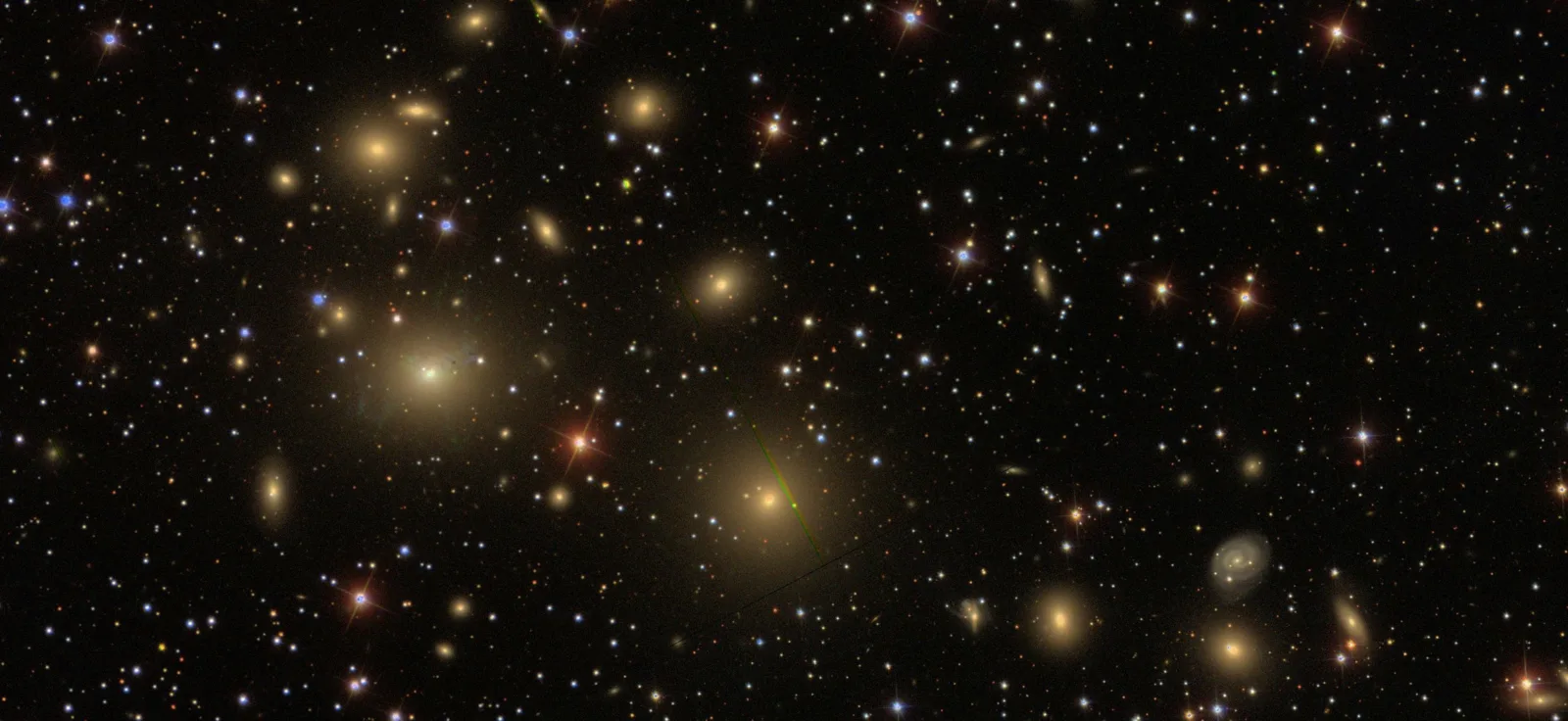
Some galaxies refuse to follow the rules. A handful of small, dense systems (NGC 1277, NGC 1271, Mrk 1216 and their kin) host black holes far larger than their modest size would suggest. They appear to be relics: massive galaxies that assembled early, around redshift two — when the universe was roughly a quarter of its present age — then drifted through cosmic time almost untouched, keeping both their compact stars and their oversized black holes. A deliberate search of the Sloan Digital Sky Survey turned up dozens of candidates: compact galaxies whose stars move at exceptionally high speeds for their size. Close study found them extreme throughout: over-massive black holes (NGC 1271, Mrk 1216), an unexpectedly massive dark-matter halo (NGC 1281) and, in one of them, a stellar population unusually rich in faint dwarf stars.
The best known is NGC 1277, a compact galaxy in the Perseus cluster. The 2012 discovery reported a black hole of about 17 billion solar masses, for a time one of the largest known, and a startling fraction of its small host. A number that big drew fire, as it should: other teams re-modelled the same galaxy and argued for masses up to ten times smaller; most of the disagreement came down to how the galaxy’s light is divided between its disk and its bulge. Higher-resolution adaptive-optics observations in 2016 reached the galaxy’s core, where the stars swarm at over 500 kilometres per second. The revised models brought the mass down by roughly a factor of three, to about five billion solar masses: inside the range the critics had argued for, yet still enormous for so small a galaxy. Where a typical galaxy’s central black hole weighs about a thousandth of its bulge — the dense knot of stars at its centre — that measurement puts NGC 1277’s at a few percent of the entire galaxy: among the most extreme ratios measured, though how extreme depends on whose decomposition of the galaxy’s light you trust. NGC 1277 looks like a frozen relic of the early universe, which hints that in some systems the black hole may have largely finished growing before its host galaxy did.
-
Bottom-heavy initial mass function in a nearby compact L* galaxy
DOI · arXiv · ADS -
Dozens of compact and high velocity-dispersion, early-type galaxies in Sloan Digital Sky Survey
DOI · arXiv · ADS -
Massive Relic Galaxies Challenge the Co-evolution of Super-massive Black Holes and Their Host Galaxies
DOI · arXiv · ADS -
MRK 1216 and NGC 1277 - an orbit-based dynamical analysis of compact, high-velocity dispersion galaxies
DOI · arXiv · ADS -
The massive dark halo of the compact early-type galaxy NGC 1281
DOI · arXiv · ADS -
The structural and dynamical properties of compact elliptical galaxies
DOI · arXiv · ADS
Orbit-based galaxy dynamics
How do you weigh a black hole, or a dark-matter halo, from a smear of starlight? Many of the masses on this page came from a single tool: a triaxial implementation of Schwarzschild’s orbit-superposition method. Triaxial means the model galaxy may have three unequal axes, closer to a bar of soap than to a ball, and that freedom matters: allowing it doubled the best-fitting black-hole mass of NGC 3379. The method builds a model galaxy out of thousands of possible stellar orbits and asks which mixture reproduces the observed image and the two-dimensional map of stellar motions. From that one fit it constrains the black-hole mass, the stellar mass-to-light ratio (how much mass each unit of starlight stands for), the dark halo and the galaxy’s true three-dimensional shape, all at once. It makes no advance assumption about how the orbits are arranged; the data decide. The method has assumptions of its own — a trial gravitational field, a galaxy in equilibrium — so every answer carries error bars, never a single neat number. The same models have been turned on giant ellipticals, dwarf spheroidals and dense nuclear star clusters alike, and used to map how stellar orbits are spread across whole populations of galaxies.
The code ran in production for over a decade on high-performance computing clusters at a dozen institutions, and lives on today in two successors: the open-source DYNAMITE in Vienna and TriOS at Berkeley.
-
The dynamical distance and intrinsic structure of the globular cluster ω Centauri
DOI · arXiv · ADS -
The SAURON project - IV. The mass-to-light ratio, the virial mass estimator and the Fundamental Plane of elliptical and lenticular galaxies
DOI · arXiv · ADS -
The Dynamical Mass-to-Light Ratio Profile and Distance of the Globular Cluster M15 (recommended)
DOI · arXiv · ADS -
The SAURON project - X. The orbital anisotropy of elliptical and lenticular galaxies: revisiting the (V/σ, ∊) diagram with integral-field stellar kinematics
DOI · arXiv · ADS -
Recovery of the internal orbital structure of galaxies
DOI · arXiv · ADS -
Triaxial orbit based galaxy models with an application to the (apparent) decoupled core galaxy NGC 4365 (recommended)
DOI · arXiv · ADS -
Stellar velocity profiles and line strengths out to four effective radii in the early-type galaxies NGC3379 and 821
DOI · arXiv · ADS -
Recovering the intrinsic shape of early-type galaxies (recommended)
DOI · arXiv · ADS -
The complex nature of the nuclear star cluster in FCC 277
DOI · arXiv · ADS -
Orbit-based dynamical models of the Sculptor dSph galaxy
DOI · arXiv · ADS -
The low dark matter content of the lenticular galaxy NGC 3998
DOI · arXiv · ADS -
Integral-field kinematics and stellar populations of early-type galaxies out to three half-light radii
DOI · arXiv · ADS -
Orbital decomposition of CALIFA spiral galaxies
DOI · arXiv · ADS -
The stellar orbit distribution in present-day galaxies inferred from the CALIFA survey
DOI · arXiv · ADS
Beyond galaxy centres
The same machinery works far from black holes. Pointed at globular clusters such as ω Centauri and M15, at dwarf galaxies, or at the diffuse dark matter around them, the models turn stellar and gas motions into a map of mass where light alone shows nothing.
The most far-reaching result came from ESO 325-G004, a galaxy that bends the light of another galaxy far behind it into arcs: a gravitational lens. The bending of that light measures the galaxy’s mass one way; the motions of its own stars measure it a second way. General Relativity predicts how the two must relate. The theory has been tested to high precision inside the Solar System, but on galaxy scales far less so. Fitting the lensed arcs and the stellar motions in a single model gave γ, the curvature of space produced per unit of mass, as 0.97 ± 0.09 — consistent with Einstein’s value of exactly 1, and at the time the most precise test of his theory of gravity ever made outside our own galaxy, published in Science in 2018.
-
Radial velocities in the globular cluster ω Centauri
DOI · arXiv · ADS -
The Central Dark Matter Distribution of NGC 2976
DOI · arXiv · ADS -
Discrete dynamical models of ω Centauri
DOI · arXiv · ADS -
The central mass and mass-to-light profile of the Galactic globular cluster M15
DOI · arXiv · ADS -
Dwarf Galaxy Dark Matter Density Profiles Inferred from Stellar and Gas Kinematics
DOI · arXiv · ADS -
An extended star formation history in an ultra-compact dwarf
DOI · arXiv · ADS -
IMF shape constraints from stellar populations and dynamics from CALIFA
DOI · arXiv · ADS -
MUSE observations of M87: radial gradients for the stellar initial-mass function and the abundance of sodium
DOI · arXiv · ADS -
A precise extragalactic test of General Relativity
DOI · arXiv · ADS
Integral-field galaxy surveys
An ordinary spectrograph records light split into its colours along one narrow slit: a single stripe across a galaxy. An integral-field unit records a whole grid of spectra at once, one at every point across a galaxy’s face, building a map rather than a stripe. That makes it possible to chart how the stars and gas move, how old they are and what they are made of, everywhere across a galaxy at the same time.
Several integral-field surveys (SAURON, CALIFA, MaNGA and VENGA), each run for years by a large international team of astronomers, did this for large, representative samples of galaxies rather than one object at a time. SAURON found that early-type galaxies (the smooth, featureless ones) split into two families: fast rotators flattened by orderly spin, and slow rotators shaped by random motion. Its maps also exposed embedded disks and counter-rotating cores that no image shows. CALIFA extended the census to galaxies of every type and, with the orbit models described above, sorted each galaxy’s stars into cold, warm and hot components, from thin orderly disks to swarming bulges. VENGA and MaNGA added the colder gas: where stars form, and how the elements forged there spread through the galaxy. Together they made the map, not the single spectrum, the standard way to read a galaxy — and the wide-angle context in which the close-up measurements above make sense.
-
The SAURON project - XII. Kinematic substructures in early-type galaxies: evidence for discs in fast rotators
DOI · arXiv · ADS -
The SAURON project - XIII. SAURON-GALEX study of early-type galaxies: the ultraviolet colour-magnitude relations and Fundamental Planes
DOI · arXiv · ADS -
The SAURON Project - XIV. No escape from Vesc: a global and local parameter in early-type galaxy evolution
DOI · arXiv · ADS -
The SAURON project - XV. Modes of star formation in early-type galaxies and the evolution of the red sequence
DOI · arXiv · ADS -
The SAURON project - XVI. On the sources of ionization for the gas in elliptical and lenticular galaxies
DOI · arXiv · ADS -
The SAURON project - XVII. Stellar population analysis of the absorption line strength maps of 48 early-type galaxies
DOI · arXiv · ADS -
The SAURON project - XVIII. The integrated UV-line-strength relations of early-type galaxies
DOI · arXiv · ADS -
The SAURON project - XIX. Optical and near-infrared scaling relations of nearby elliptical, lenticular and Sa galaxies
DOI · arXiv · ADS -
The SAURON project - XX. The Spitzer [3.6] - [4.5] colour in early-type galaxies: colours, colour gradients and inverted scaling relations
DOI · arXiv · ADS -
The SAURON project - XXI. The spatially resolved UV-line strength relations of early-type galaxies
DOI · arXiv · ADS -
The VIRUS-P Exploration of Nearby Galaxies (VENGA): Survey Design, Data Processing, and Spectral Analysis Methods
DOI · arXiv · ADS -
The VIRUS-P Exploration of Nearby Galaxies (VENGA): The XCO Gradient in NGC 628
DOI · arXiv · ADS -
The VIRUS-P Exploration of Nearby Galaxies (VENGA): Radial Gas Inflow and Shock Excitation in NGC 1042
DOI · arXiv · ADS -
The VIRUS-P Exploration of Nearby Galaxies (VENGA): spatially resolved gas-phase metallicity distributions in barred and unbarred spirals
DOI · arXiv · ADS -
CALIFA, the Calar Alto Legacy Integral Field Area survey. IV. Third public data release
DOI · arXiv · ADS -
Stellar kinematics across the Hubble sequence in the CALIFA survey: general properties and aperture corrections
DOI · arXiv · ADS -
The CALIFA view on stellar angular momentum across the Hubble sequence
DOI · arXiv · ADS -
Overview of the SDSS-IV MaNGA Survey: Mapping nearby Galaxies at Apache Point Observatory
DOI · arXiv · ADS -
SDSS-IV MaNGA IFS Galaxy Survey—Survey Design, Execution, and Initial Data Quality
DOI · arXiv · ADS -
Sloan Digital Sky Survey IV: Mapping the Milky Way, Nearby Galaxies, and the Distant Universe
DOI · arXiv · ADS -
The 13th Data Release of the Sloan Digital Sky Survey: First Spectroscopic Data from the SDSS-IV Survey Mapping Nearby Galaxies at Apache Point Observatory
DOI · arXiv · ADS -
The Fourteenth Data Release of the Sloan Digital Sky Survey: First Spectroscopic Data from the Extended Baryon Oscillation Spectroscopic Survey and from the Second Phase of the Apache Point Observatory Galactic Evolution Experiment
DOI · arXiv · ADS
Black holes are invisible, but their masses are written in the motions of stars. This work helped build the tools that read those motions, and with them turned black holes from one-off curiosities into a measured population: most on a common relation, the exceptions just as telling about how galaxies grow. The data are public, the code lives on in its successors, and the weighing continues.